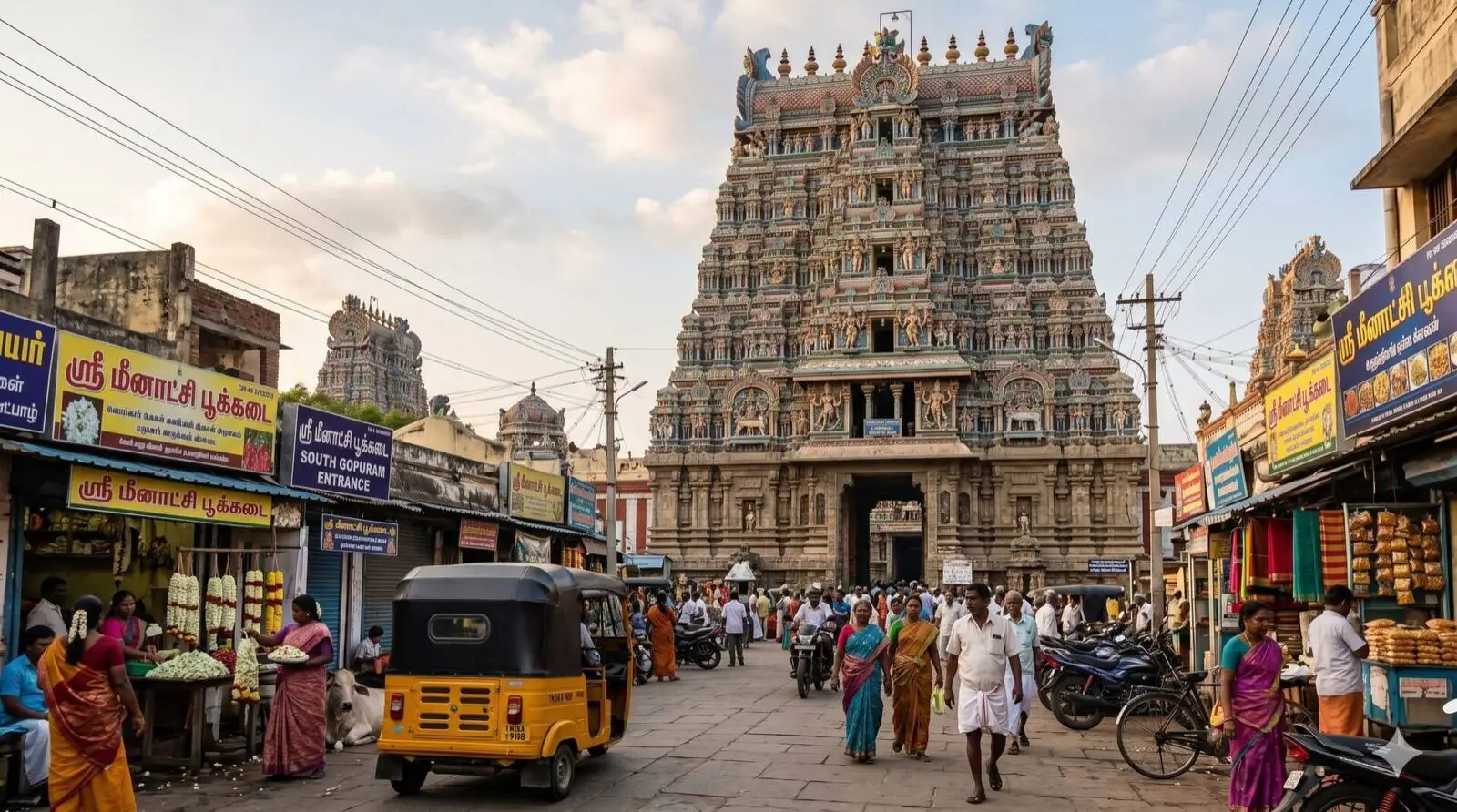
Madurai · Tamil Nadu · Living Temple
Complex open · inner sanctum restrictedMeenakshi Amman Temple
Not a building you visit so much as a walled city you enter. Fourteen gopurams, 985 carved pillars, and a goddess who takes precedence over her own husband.
Madurai's great temple is dedicated to Meenakshi — the fish-eyed goddess who ruled the city as a warrior queen before marrying Shiva — and to her consort Sundareswarar. Unusually for a Hindu temple, the goddess takes precedence. Pilgrims visit her shrine first.
What you are actually looking at
The complex covers roughly fourteen acres inside a rectangular walled enclosure, with fourteen gateway towers rising over it. The tallest — the southern gopuram, built in 1559 — climbs past 52 metres and carries something in the order of fifteen hundred painted stucco figures across its tiers. Every twelve years the whole thing is repainted in the same vivid palette, which is why it looks nothing like a weathered ruin and everything like a living object.
Inside are two separate temples sharing one enclosure. Meenakshi's shrine and Sundareswarar's each have their own sanctum, their own gopuram, their own priests and their own daily rhythm. The relationship between them structures the whole building — and the whole day.
The history, briefly
The site is old and the building is not. Pandya-era foundations were sacked by Malik Kafur's forces in the early fourteenth century and the temple was substantially destroyed. It was rebuilt under Vijayanagara patronage and then vastly expanded by the Madurai Nayaks — above all Thirumalai Nayak, who ruled from 1623 to 1659 and gave the complex most of the scale it has today.
That sequence matters when you look at it. The proportions are Nayak-period: outward-spreading, gateway-dominated, theatrical. If you have already seen a Chola temple like Thanjavur, where the tower over the sanctum is the tall element, Madurai will read as its opposite — and it is, deliberately.
The thousand-pillar hall — which has 985
The Ayirakkal Mandapam is the single most photographed interior in the temple, built by Ariyanatha Mudaliar, a Nayak general. The name promises a thousand pillars; the actual count is 985, and no two are carved alike. It now houses a temple art museum, which means you can look at the pillars properly rather than being moved along.
Near the eastern entrance stand the musical pillars — slender stone columns which ring with distinct sustained notes when struck. They are roped off now, having been damaged by a century of visitors testing them, but a guide can demonstrate on the ones still permitted.
The nightly palanquin ceremony
This is the reason to still be inside the temple at the end of the day, and most visitors miss it because they come in the afternoon.
Each night, at around half past nine, Sundareswarar is carried in a palanquin from his own shrine to Meenakshi's chamber, accompanied by drums, conch and a small procession. In the morning he is carried back. It has happened every night for centuries, and watching a marriage re-enacted nightly in a building this size is a genuinely strange and moving thing.
There is no ticket and no special access. You simply need to be there, and to know it is coming.
What to look for
The Potramarai Kulam, the golden lotus tank at the centre, with its colonnade and its reflection of the southern gopuram. Traditionally, works of Tamil literature were judged by throwing them into this tank — what floated was worth keeping.
The painted ceiling of the corridor around the tank, and the sequence of Nayak-period murals.
The stucco figures on the gopurams at close range rather than from a distance. Bring a long lens or binoculars if you have them; the upper tiers reward it and almost nobody looks.
The flower and bangle market in the streets immediately outside, which functions as it has for centuries and is part of the temple rather than separate from it.
The city is part of the temple
Madurai was not built and then given a temple. The city was laid out around it, in concentric rectangular streets radiating from the sanctum — Chittirai Street, Avani Moola Street, Masi Street — each ring named after a month of the Tamil calendar.
That plan is still legible on a map and still governs how the city works. The great festival processions move along these rings, each ring corresponding to the scale of the occasion, so the street grid functions as a set of ceremonial orbits. It is one of the most complete surviving examples of a South Indian temple town, and it explains why Madurai feels organised around a centre in a way most Indian cities do not.
The practical consequence for a visitor is that you should walk the rings. The flower market, the brassware shops, the tailors and the banana vendors are not incidental to the temple economy — they are it, and have been for centuries.
Chithirai — the divine wedding
If you can time a visit to one festival in Madurai, this is it. The Chithirai Thiruvizha, over roughly two weeks in April or May, stages the marriage of Meenakshi and Sundareswarar as a civic event on an enormous scale.
Meenakshi is crowned, conquers the three worlds in procession, and is married. Simultaneously her brother — identified as Vishnu, in the form of Kallazhagar — sets out from the Alagar Koyil temple eighteen kilometres away to attend the wedding, arrives late, discovers it has happened without him, and turns back. His entry into the Vaigai river, on a golden horse, draws crowds in the high hundreds of thousands.
The fusing of a Shaiva and a Vaishnava festival into one civic drama is unusual and historically significant. It is also, practically, the single most crowded fortnight of the Madurai year — book accommodation eight to nine months out or you will not find any.
Planning a Visit
Entry & access
The complex is open to visitors of any faith. Non-Hindus may enter the complex but not the two inner sanctums — this is enforced and not negotiable. Everything else, including the thousand-pillar hall, the tank and the corridors, is open to everyone.
Timings
Open 05:00–12:30 and 16:00–22:00 daily, with the long midday closure standard across South Indian temples. General darshan begins around thirty minutes after opening. Entry is free; a paid special darshan exists for those who want to bypass the queue, bookable through the Tamil Nadu HRCE portal at hrce.tn.gov.in. The nightly palanquin ceremony is around 21:30. Hours shift by fifteen to thirty minutes on festival days.
Dress
Shoulders and knees covered. Shoes are removed before the outer gate, and you will walk a considerable distance barefoot on stone — go early, when it is still cool.
Photography
Cameras and phones are generally restricted inside and often must be deposited. Assume you will not be photographing the sanctums. The gopurams from outside are unrestricted.
How long to allow
Two hours minimum, three to do it properly. Half a day if you want both the morning and the evening rhythms.
Best time
November to March for weather. Pongal in mid-January turns the temple streets into a four-day procession; the Chithirai Festival in April or May stages the divine wedding at enormous scale.
Timings, fees and access rules above were checked in July 2026, but temple administrations change them with the festival calendar and sometimes at short notice. We reconfirm hours, darshan arrangements and any restrictions before every departure — and we book priority darshan in advance where it exists, because the queue is usually the difference between a good visit and a wasted morning.
Travel with us
See This Properly
Private, guided, and timed so you are inside when it matters rather than at the same hour as everyone else.
Start planning →Meenakshi Amman Temple, Answered
Yes, into the complex — but not into the two inner sanctums of Meenakshi and Sundareswarar. That restriction is enforced at the sanctum entrance. The thousand-pillar hall, the golden lotus tank, the corridors and all fourteen gopurams are open to everyone.
Fourteen. The tallest is the southern gopuram, built in 1559, rising past 52 metres. The oldest is the eastern tower, dating to the reign of Maravarman Sundara Pandyan in the thirteenth century.
No — 985. It was built by Ariyanatha Mudaliar, a Nayak general, and no two pillars are carved alike. It now houses a temple art museum.
Early morning for atmosphere and cool stone, or evening for the palanquin ceremony at around 21:30, when Sundareswarar is carried to Meenakshi's chamber for the night. Midday is the worst — the temple closes for several hours and the stone is painfully hot.
Two hours minimum. Three to see it properly. Half a day if you want to experience both the morning and evening rituals, which are quite different from each other.
For most people, yes. It is among the very few Indian temples that justify a dedicated journey. That said, Madurai pairs naturally with the Chola temples at Thanjavur and Trichy, and with Chettinad for its mansions and food.
Where to Next
Or start with the full Temples of India guide — 120 temples, eleven circuits, architecture and etiquette.
Planning a trip to Meenakshi Amman Temple, Madurai?
Tell us roughly what you have in mind and we will send a considered reply — not a brochure. Usually within 24 hours, Kolkata office hours.