Dwarka · Gujarat · Char Dham
Complex open · inner sanctum restrictedDwarkadhish Temple
Krishna's capital, said to have been swallowed by the sea — and a temple flag changed five times a day, every day, by the same family.
Dwarka is one of the four original Char Dham and one of the seven Sapta Puri — the cities that grant liberation. It is held to be the capital Krishna built after leaving Mathura, and to have been reclaimed by the sea after his death.
The submerged city
The tradition is specific: Krishna built a great city here, and when he died the sea took it back. This is not a vague legend — texts describe the city, its gates and its scale.
Marine archaeology off this coast has found submerged structures — stone blocks, what appear to be walls and jetties, in shallow water near the modern town. Surveys by the National Institute of Oceanography from the 1980s onward recovered material and mapped features.
What that material actually is remains contested. Dating is difficult in shallow marine conditions, and interpretations range from a genuine ancient port to natural formations and later harbour works. Anyone telling you it definitively confirms the Mahabharata account is going beyond the evidence, and so is anyone dismissing it entirely.
What is not in doubt is that this coast held significant ancient ports, and that the site has been continuously important for a very long time.
The temple and its flag
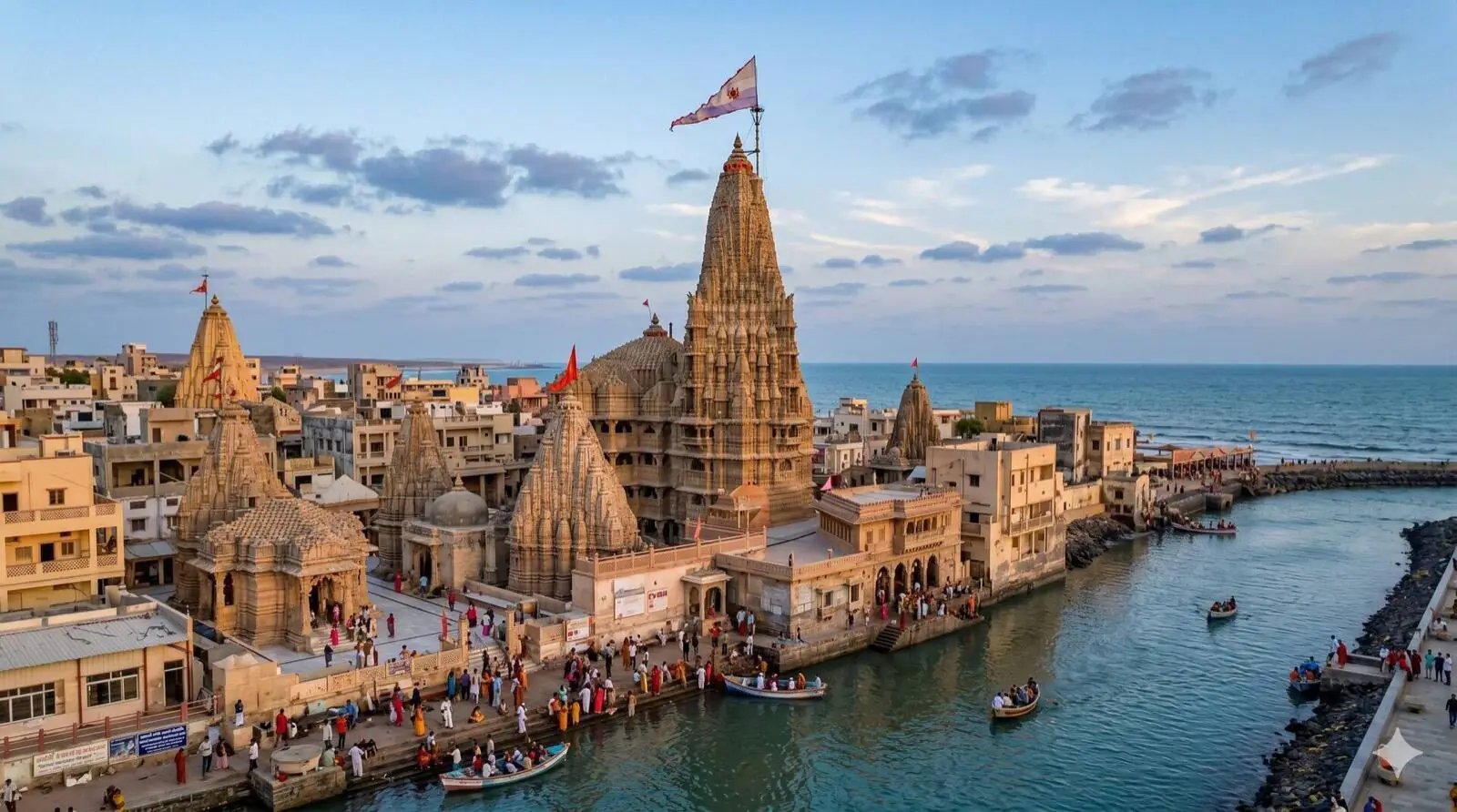
The Dwarkadhish or Jagat Mandir stands five storeys on seventy-two carved pillars, with a spire rising around seventy-eight metres above the Gomti creek where it meets the Arabian Sea. The present structure is largely fifteenth and sixteenth century on much older foundations; parts are attributed to the Chalukya period.
Above it flies a triangular flag — the Dwajaji — bearing the sun and moon, and it is changed five times every day. Not once, five times. The right to make the flag and perform the change belongs to particular families, the cloth is donated by devotees, and the queue to sponsor a change runs months long.
The flag is roughly fifty-two yards of cloth and the climb to change it is made by hand. Watching one of the five is a small, unglamorous, entirely genuine thing and takes ten minutes.
There are two gates: Swarga Dwar (gate of heaven) for entry and Moksha Dwar (gate of liberation) for exit. Fifty-six steps lead up from the Gomti ghat.
Bet Dwarka and Nageshwar
Bet Dwarka is an island about 30 km north, reached by ferry from Okha, and is held to be where Krishna actually lived rather than ruled. The temple there is where the Sudama story is set — the poor childhood friend who arrives with a handful of beaten rice. It is a rougher, less polished pilgrimage than the main temple and better for it. A new signature bridge now connects the island, changing the visit considerably.
Nageshwar, between Dwarka and Bet Dwarka, is one of the twelve Jyotirlingas — marked by an enormous seated Shiva figure visible from the road long before the temple. It takes twenty minutes and it completes a set.
Rukmini Devi temple, 2 km out, is architecturally the finest thing in the area — twelfth century, and separated from the main temple by a story about a sage's curse that explains why husband and wife are worshipped apart.
Gopi Talav and the yellow clay taken from it, and the Sudama Setu footbridge across the creek, fill an afternoon.
Dwarka in a Gujarat itinerary
Dwarka is at the far western tip of Saurashtra and is almost always visited on a loop rather than alone.
Somnath is 230 km south — the first Jyotirlinga, destroyed and rebuilt seven times. With Nageshwar that gives two Jyotirlingas and a Char Dham on one coastal drive.
Porbandar, Gandhi's birthplace, sits between them.
Gir, for wild Asiatic lions, is inland from Somnath.
Janmashtami in August or September is Dwarka's great festival and the town is transformed. It is also the hardest time to find a bed — book many months ahead.
Planning a Visit
Timings
06:30–13:00 and 17:00–21:30 daily. Timings shift during Janmashtami, Holi, Ekadashi, Diwali and Govardhan Puja. Entry is free. Verified August 2026.
The flag
Changed five times daily. Sponsorship is booked months ahead. Watching a change takes about ten minutes and is worth timing your visit around.
Security
Phones, cameras, bags and leather items are deposited before entry. Free lockers near the gate.
Bet Dwarka
About 30 km north, reached from Okha — now also by a new signature bridge. Held to be where Krishna lived rather than ruled. Allow half a day including Nageshwar on the way.
Getting there
Nearest airports Jamnagar (130 km) and Porbandar (100 km); Dwarka has a mainline railway station. Usually driven as part of a Saurashtra circuit with Somnath, Porbandar and Gir.
Best time
October to March. Janmashtami (August–September) is the great festival and the busiest week of the year — book many months out.
Timings, fees and access rules above were checked in July 2026, but temple administrations change them with the festival calendar and sometimes at short notice. We reconfirm hours, darshan arrangements and any restrictions before every departure — and we book priority darshan in advance where it exists, because the queue is usually the difference between a good visit and a wasted morning.
Travel with us
See This Properly
Private, guided, and timed so you are inside when it matters rather than at the same hour as everyone else.
Start planning →Dwarkadhish Temple, Answered
Marine archaeology off this coast has found submerged structures — stone blocks and features that appear to be walls and jetties — surveyed from the 1980s onward. What that material is remains contested: dating is difficult in shallow marine conditions and interpretations range from an ancient port to natural formations and later harbour works. It neither confirms nor refutes the textual account.
It is the temple's central daily ritual. The triangular Dwajaji bears the sun and moon, is roughly fifty-two yards of cloth, and is changed by hand five times daily by families holding the hereditary right. Sponsorship is donated by devotees and the queue runs months long.
06:30–13:00 and 17:00–21:30 daily, with changes during Janmashtami, Holi, Ekadashi, Diwali and Govardhan Puja. Entry is free. Phones, cameras and leather must be deposited. Verified August 2026.
Yes — one of the four original Char Dham established by Shankaracharya, alongside Badrinath, Puri and Rameswaram. It is also one of the seven Sapta Puri cities held to grant liberation. Not to be confused with the Himalayan Chota Char Dham — see our Char Dham guide.
An island about 30 km north, reached from Okha and now also by a new bridge, held to be where Krishna actually lived rather than ruled. The Sudama story is set there. It is rougher and less polished than the main temple, and better for it.
Yes — Nageshwar, between Dwarka and Bet Dwarka, is one of the twelve, marked by an enormous seated Shiva visible from the road. With Somnath 230 km south, a Saurashtra trip covers two Jyotirlingas and a Char Dham.
Where to Next
Or start with the full Temples of India guide — 120 temples, eleven circuits, architecture and etiquette.
Planning a trip to Dwarkadhish Temple, Dwarka?
Tell us roughly what you have in mind and we will send a considered reply — not a brochure. Usually within 24 hours, Kolkata office hours.