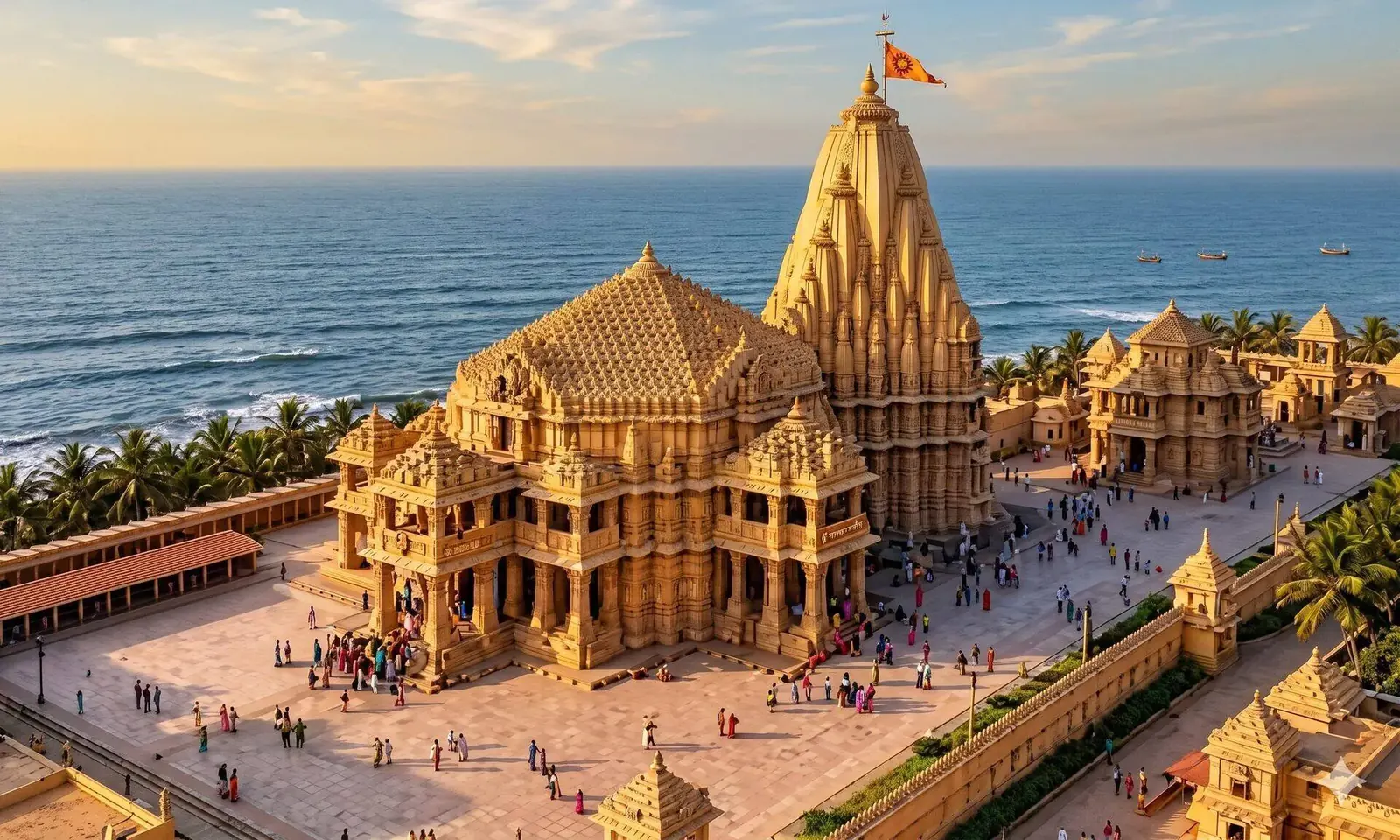
Veraval · Gujarat · Jyotirlinga
Complex open · inner sanctum restrictedSomnath Temple
First of the twelve Jyotirlingas, destroyed and rebuilt more times than any other temple in India, and rebuilt again in 1951 as a statement about what independence meant.
Somnath is the first of the twelve Jyotirlingas and the most destroyed important building in India. It has been razed and rebuilt something like seven times across a thousand years. The temple standing today was completed in 1951, and its construction was a political act as much as a religious one.
A history of demolition
The sequence is long and disputed in detail, but the outline is not. A temple has stood on this coast since at least the early medieval period. It was sacked by Mahmud of Ghazni in 1026, an event that entered both Persian and Indian historical memory and has been retold, embellished and politicised ever since. It was rebuilt, and destroyed again — under the Delhi Sultanate, under Gujarat's sultans, and finally under Aurangzeb in the seventeenth century.
Historians disagree sharply about the scale of the 1026 raid, what was actually there to be looted, and how much of the later narrative is nineteenth-century construction. What is not in dispute is that the site was repeatedly attacked and repeatedly rebuilt, over roughly a thousand years, by people who kept coming back.
That persistence is the actual story of Somnath, and it is more interesting than any single sacking.
1951 — the rebuilding as statement
The present temple was begun immediately after independence, driven by Sardar Vallabhbhai Patel, and completed in 1951. India's first President, Rajendra Prasad, performed the installation ceremony — over the objection of Prime Minister Nehru, who thought a secular state should not be rebuilding temples.
That disagreement is worth knowing about, because it is one of the founding arguments of the Indian republic conducted over a specific building. Somnath is not a neutral site and has never pretended to be.
The reconstruction was done in the Chalukya or Solanki style — the Gujarati Nagara idiom — by traditional temple architects working from śilpa texts rather than modern design. It is a twentieth-century building executed by eleventh-century method, and it is very good.
The arrow pillar
On the sea wall behind the temple stands the Baan Stambh, the arrow pillar. An inscription on it states that there is no land in a straight line between this point and the South Pole.
Check it on a globe and it is essentially correct — the meridian running south from this stretch of the Gujarat coast crosses open ocean all the way to Antarctica. Whoever placed the marker understood the geography well enough to make a claim that holds.
The inscription's age is uncertain and it is probably not as old as popularly claimed. But standing at the wall with the Arabian Sea in front of you and knowing there is nothing between you and the ice is a genuine thing, whatever the date on the stone.
What to see, and when
The temple sits directly on the shore, and the sound of the sea is constant inside it. This is unusual and it changes the atmosphere entirely — most great Indian temples are inland and enclosed.
Aarti at 07:00, 12:00 and 19:00. The evening one, with the sea behind, is the one to be there for.
The light and sound show runs 20:00–21:00 outside the monsoon, projected onto the temple itself, and covers the destruction-and-rebuilding history.
The Somnath Museum nearby holds fragments of the earlier temples — carved stones recovered from the site — which makes the layered history concrete rather than narrative.
Bhalka Tirth, a few kilometres away, is where Krishna is held to have been struck by a hunter's arrow and to have died, and Dehotsarg on the Hiran river is where he was cremated. For a coastline this size, it carries a great deal.
Somnath in a Gujarat itinerary
Somnath is rarely visited alone, and the pairings are good.
Dwarka, 230 km up the coast, is one of the four original Char Dham and holds the Dwarkadhish temple — and Nageshwar, near Dwarka, is another of the twelve Jyotirlingas. Two Jyotirlingas and a Char Dham on one coastal drive.
Gir, the only place in the world with wild Asiatic lions, is about 45 km inland.
Junagadh and Girnar are within reach, which brings in the Jain tirths — Girnar is where Neminath, the twenty-second Tirthankara, is held to have attained liberation. See the Jain tirths guide.
Palitana, the hill of nine hundred temples where nobody may sleep, is around 200 km northeast and is the single most extraordinary religious site in Gujarat.
Planning a Visit
Timings
06:00–22:00 daily. Aarti at 07:00, 12:00 and 19:00. General darshan is free — there is no entry ticket, and nobody should be selling you one. VIP darshan passes exist at roughly ₹50–200 depending on the day. Verified August 2026.
Light & sound show
20:00–21:00, projected onto the temple, suspended during the monsoon. Covers the destruction-and-rebuilding history and is worth staying for.
Security
Strict. Phones, cameras, bags and leather items must be deposited at counters before entry. Free lockers are provided. Plan for it rather than arriving with valuables.
Access
Wheelchairs and a golf cart are available at the main gate for elderly and mobility-impaired visitors, and there is a lift inside the premises. Somnath is among the better-equipped major temples in this respect.
Mahashivratri
15 February 2026. The temple often stays open through the night for the four prahar pujas and the crowds are very large. Security is heavier and schedules shift — worth being there, worth booking early.
Getting there
Nearest airport Diu (90 km) or Rajkot (200 km); Veraval railway station is 7 km. Usually driven as part of a Saurashtra circuit with Dwarka, Gir and Junagadh.
Timings, fees and access rules above were checked in July 2026, but temple administrations change them with the festival calendar and sometimes at short notice. We reconfirm hours, darshan arrangements and any restrictions before every departure — and we book priority darshan in advance where it exists, because the queue is usually the difference between a good visit and a wasted morning.
Travel with us
See This Properly
Private, guided, and timed so you are inside when it matters rather than at the same hour as everyone else.
Start planning →Somnath Temple, Answered
Around seven times across roughly a thousand years — most famously by Mahmud of Ghazni in 1026, and later under the Delhi Sultanate, Gujarat's sultans and Aurangzeb. Historians disagree about the scale of individual raids and how much of the later narrative is nineteenth-century construction, but the pattern of repeated destruction and rebuilding is not disputed.
Completed in 1951, driven by Sardar Vallabhbhai Patel immediately after independence, with President Rajendra Prasad performing the installation — over Nehru's objection that a secular state should not rebuild temples. It was constructed in the Chalukya/Solanki style by traditional temple architects working from śilpa texts.
The arrow pillar on the sea wall, inscribed with the claim that there is no land in a straight line between that point and the South Pole. Checked against a globe the claim essentially holds — the meridian south from this coast crosses open ocean to Antarctica. The inscription is probably not as old as popularly stated.
06:00–22:00 daily, with aarti at 07:00, 12:00 and 19:00, and a light and sound show 20:00–21:00 outside the monsoon. General darshan is free. Verified August 2026 — reconfirm before travel.
The first of the twelve, in the traditional order that runs from Somnath in Gujarat to Grishneshwar in Maharashtra. Nageshwar, near Dwarka up the same coast, is another — so a Saurashtra trip covers two. See our Jyotirlinga guide.
Dwarka (230 km, a Char Dham) and Nageshwar (another Jyotirlinga), Gir for wild Asiatic lions (45 km), Girnar and Palitana for the Jain tirths, and Bhalka Tirth nearby, where Krishna is held to have died.
Where to Next
Or start with the full Temples of India guide — 120 temples, eleven circuits, architecture and etiquette.
Planning a trip to Somnath Temple?
Tell us roughly what you have in mind and we will send a considered reply — not a brochure. Usually within 24 hours, Kolkata office hours.