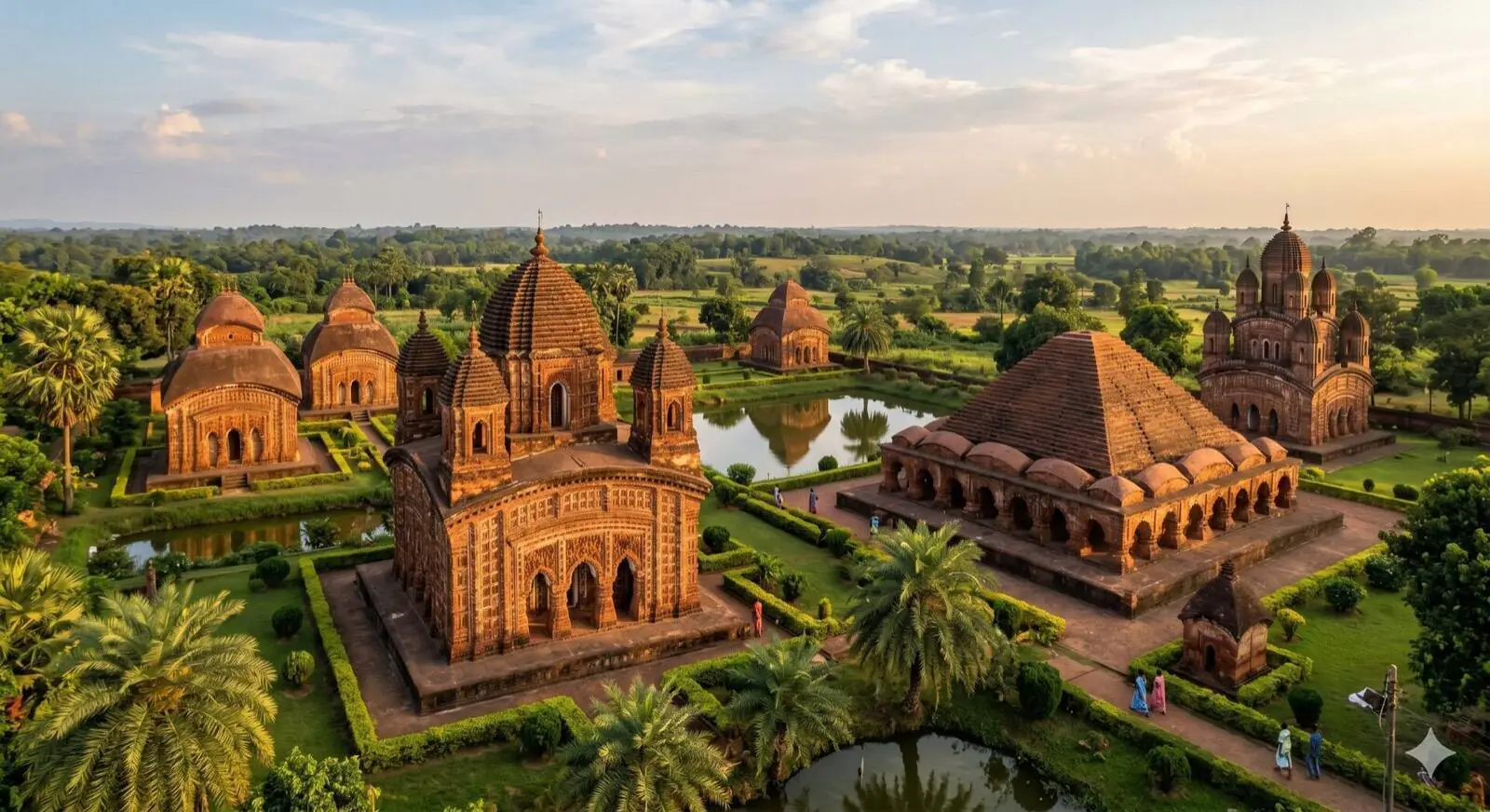
Bengal · Bankura
Bishnupur Terracotta Temples
No stone, no marble, no granite — just alluvial clay, and a dynasty that turned the limitation into the most distinctive temple architecture in eastern India.
Bengal has no building stone. The delta is alluvium for hundreds of miles. So when the Malla kings of Bishnupur wanted temples, they fired the ground itself into brick and carved the brick into narrative.
Architecture out of a shortage
Almost every great Indian temple tradition rests on available rock — granite in the Tamil country, sandstone in Rajasthan, basalt at Ellora. The Bengal delta has none of it.
What it has is clay. The Malla rulers of Bishnupur, at their height in the seventeenth century under Bir Hambir and his successors, built in fired brick and then faced the brick in terracotta panels — moulded and carved plaques covering the walls in continuous narrative.
The result is a style that exists nowhere else at this quality. It is also, structurally, why so much has been lost: brick and clay do not survive Bengal’s monsoon the way granite survives a Tamil summer.
The roof that came from a hut
The other Bengal signature is the chala roof — the curved, downward-sloping cornice you see on almost every temple here.
It is copied directly from the thatched bamboo village hut, whose roof curves because bamboo bends under weight. Masons reproduced that curve in brick, and it became the defining line of Bengali sacred architecture. Do-chala, char-chala and at-chala describe two, four and eight roof segments.
The style then travelled — the curved Bengali cornice was borrowed into Mughal architecture and turns up as far away as Punjab and Rajasthan.
The temples worth your time
Around twenty structures survive. These four earn the visit:
- Rasmancha (c. 1600) — the oldest and strangest. A pyramidal brick structure on a square plinth, built not to house a deity permanently but to display all of Bishnupur’s Krishna idols together during the Ras festival. There is nothing else like it in India.
- Jor Bangla — two do-chala huts joined under one tower, and the most refined terracotta on the site. The Ramayana panels here are the ones to study.
- Shyam Rai (1643) — the pancharatna, five-towered, with the densest carving. Krishna’s life covers nearly every surface.
- Madan Mohan (1694) — a single tower, ekaratna, with fine Krishna-lila and Ramayana panels.
How to read the terracotta
The panels are not decorative. They are narrative, and once you know what you are looking at they become extraordinarily rich.
Expect Krishna-lila and Ramayana scenes, but also — and this is what makes Bishnupur unusual — everyday seventeenth-century Bengal. Hunting parties. Boats on rivers. Musicians. Court scenes. Portuguese soldiers with muskets, recorded by craftsmen who had evidently seen them.
Very few Indian monuments give you this much secular observation. Bring binoculars or a long lens; much of the best work sits above eye level.
Baluchari and the rest
Bishnupur is also the home of the Baluchari sari — silk woven with narrative pallu panels depicting scenes from the Mahabharata and Ramayana, the same storytelling instinct as the terracotta transferred to cloth. Weavers still work in the town and will show you the looms.
The town is a centre for Bishnupur gharana classical music, and for Dokra lost-wax metal casting in the surrounding villages.
Planning a Visit
Timings and tickets
The ASI-protected temples are open 09:00–17:00. A single ASI ticket covers Rasmancha, Shyam Rai, Jor Bangla and Madan Mohan — buy it at Rasmancha, which most people reach first.
How long
A half day covers the main four at a decent pace. A full day lets you add the outlying temples, a weaver’s workshop and the Dokra villages.
Getting there
About 140 km from Kolkata, three to four hours by road. Trains run to Bishnupur from Howrah. It pairs naturally with Shantiniketan.
Getting around
The temples are spread across the town, not in one compound. A cycle-rickshaw or auto for the morning is the usual way and costs very little.
When to go
October to March. The terracotta reads best in low, raking light — early morning or late afternoon — because the relief needs shadow to show. Midday flattens it completely.
What to bring
Binoculars or a zoom lens. The finest panels are well above head height and most visitors never actually see them.
Bishnupur is the one Bengal site where a guide changes the experience most — the panels are unreadable without someone to point out what is happening in them.
Travel with us
See This Properly
We build Bishnupur into our rural Bengal journeys with a local guide who reads the terracotta, and we time the visit for the light rather than the itinerary.
Start planning →Bishnupur Terracotta Temples, Answered
Because the Bengal delta is alluvial and has no building stone. The Malla rulers fired local clay into brick and faced it with carved terracotta panels, creating a style found nowhere else at this quality.
Rasmancha, Jor Bangla, Shyam Rai and Madan Mohan are the essential four. Rasmancha is the oldest and most unusual; Jor Bangla and Shyam Rai carry the finest carving.
The curved, downward-sloping roof characteristic of Bengali temples, copied from the thatched bamboo village hut whose roof bends under weight. Do-chala, char-chala and at-chala describe two, four and eight roof segments.
About 140 km, three to four hours by road. Trains also run from Howrah. It pairs naturally with a Shantiniketan visit.
Early morning or late afternoon. Terracotta relief needs raking light and shadow to read; midday sun flattens the carving and you lose most of the detail.
Baluchari silk saris woven with Mahabharata and Ramayana scenes, the Bishnupur gharana of classical music, and Dokra lost-wax metal casting in the surrounding villages.
Where to Next
Planning a trip to Bishnupur Terracotta Temples: Malla Architecture &?
Tell us roughly what you have in mind and we will send a considered reply — not a brochure. Usually within 24 hours, Kolkata office hours.