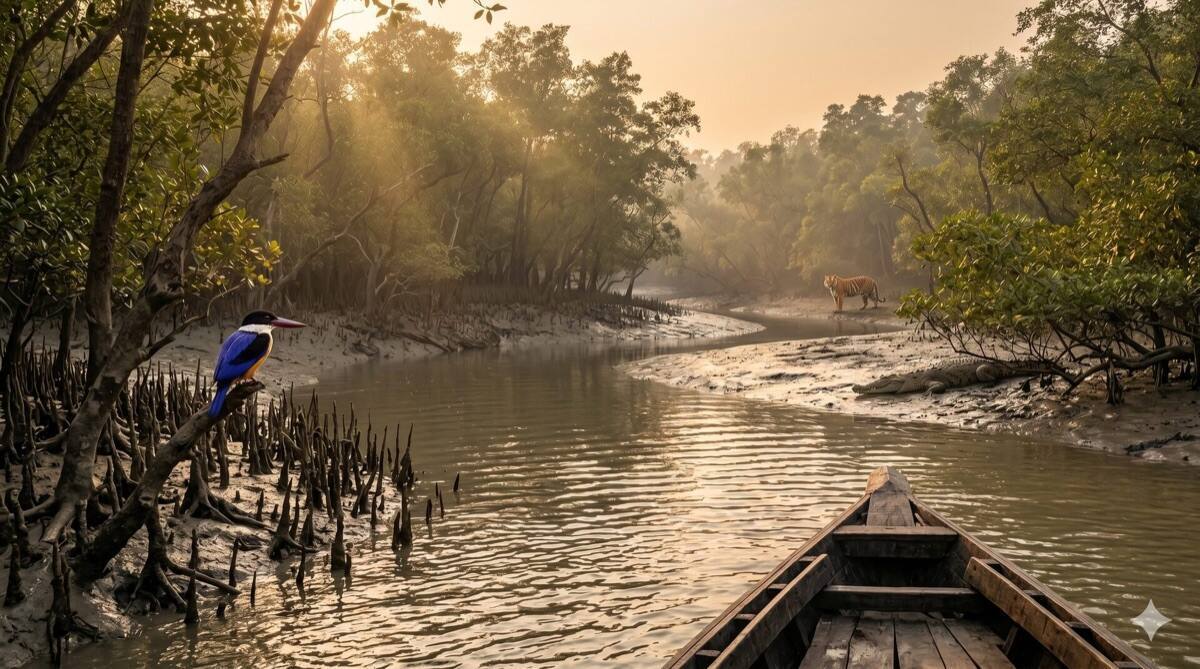
For five days each autumn, the city of Kolkata becomes the largest open-air art gallery in the world. Thirty thousand temporary pavilions appear in courtyards, parks, and street corners — each a complete artistic installation built around an idol of the goddess Durga. Forty-five million people walk between them. The energy is unlike any other festival on earth, and in 2021, UNESCO finally agreed.
This is the most thorough guide we know how to write about it.
We've covered Durga Puja with cameras and notebooks for seven years. We've stayed up for Sandhi Puja at midnight in dozens of pandals; we've watched the sun rise over Prinsep Ghat on Mahalaya morning while the radio played the same chant that's played there for a hundred years. The piece below is the version we wish had existed when we first tried to explain Durga Puja to a curious traveller. If you're booking a trip, planning a film, writing about Bengal, or just genuinely curious about why this festival earned UNESCO recognition — start here.
One housekeeping note. Dates for 2027 (provisional until the Bengali almanacs for 1434 are published): Mahalaya falls on Thursday 30 September, and the main days run October 5 to 10 (Sasthi through Vijaya Dashami, with Ashtami spanning Thursday and Friday). The city begins its visible transformation in late September. If you can travel between September 29 and October 11, you'll see the festival in its full arc.
The Origin Story: Mythology and Memory
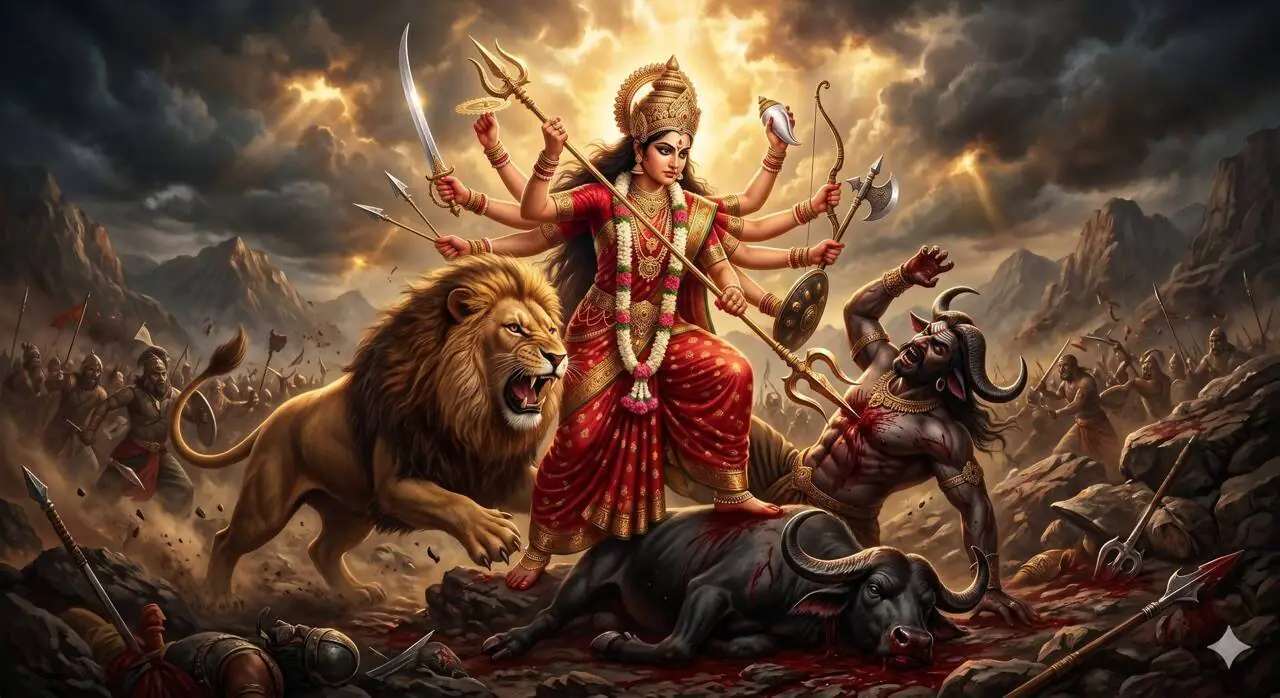
The mythological core is older than the historical event. Durga, in the Hindu tradition, is the warrior form of the divine feminine — the supreme goddess, the protector, the destroyer of injustice. The story most associated with her in Bengal centres on a buffalo-demon called Mahishasura who could not be killed by any man or god. The gods, defeated, pooled their combined power into a single female form — Durga, mounted on a lion, wielding ten weapons in ten arms.
She fought Mahishasura for nine nights. On the tenth day, she killed him. That tenth day is what Bengalis call Vijaya Dashami, the day of victory — the festival's emotional finale.
This is the official story. But what makes Durga Puja in Kolkata so unusual is that the festival is also, equally, about something far more domestic: the goddess returning home.
In Bengali folk imagination, Durga is not just a cosmic warrior. She is also a married daughter coming back to her parents' house — to baaper baari — for a five-day visit. She brings her four children with her (Lakshmi the goddess of prosperity, Saraswati the goddess of learning, Ganesh, and Kartik). The husband — Shiva — stays at home in the Himalayas. The household is welcoming her back, feeding her, celebrating her, and then on Dashami, with collective heartbreak, sending her off again.
Bengal worships Durga twice over — as a warrior who defends the world, and as a daughter who briefly comes home.
This second register is what gives the festival its emotional weight. The five days are not abstract piety; they are a family visit that the entire city participates in. The bidaai (farewell) at Bisarjan on Dashami isn't sad just because the puja is over — it's sad because she's leaving again.
A Brief History: From Royal Courtyard to UNESCO Stage
The puja itself is ancient, with references in scriptures going back centuries. But the Durga Puja of Kolkata — the public, theatrical, art-festival version — has a more specific history that's worth tracing.
1610: The First Family Puja
Most historians date the first major family Durga Puja to 1610, organised by the Sabarna Roy Chowdhury family at their Barisha estate (now a suburb of Kolkata). It was a private affair — the celebration of a wealthy zamindar (landlord) family, modelled on older puja traditions from rural Bengal. Their puja is still observed in the same household, by descendants of the same family, in 2026. That's an unbroken 416-year tradition.
1757–1790: Babu Culture and the Public Puja
The shift from private aristocratic puja to something more public began in the late 18th century. After the British East India Company defeated Siraj-ud-daulah at the Battle of Plassey (1757), a new class of wealthy Bengali merchants and zamindars emerged — the "babus" — many of whom made fortunes trading with the British. They invested some of that wealth in extravagant private pujas as a statement of social standing.
Raja Nabakrishna Deb of Shobhabazar held what's often cited as Kolkata's first "celebratory" public Durga Puja in 1757 — partly, it's said, to mark the British victory. The babus' pujas of the late 18th and early 19th centuries became famous for their scale: jewelled idols, imported chandeliers, nautch dancers, lavish feasts, and sometimes Europeans invited as honoured guests.
1790: Bowarir Tala — the Twelve Friends
The first true community-funded public puja — what Bengalis call a barowari puja (literally "twelve friends") — was organised in 1790 at Guptipara in Hooghly district, just outside Kolkata. Twelve neighbours pooled resources to hold a puja together, removing it from any single family's patronage. This is the genetic ancestor of every modern community puja in the city.
1910–1919: Bhowanipore, Bagbazar and the Sarbojanin Era
By the early 20th century, the colonial public sphere was changing. Nationalism was rising. Mass culture was emerging. Around 1910, the Sanatan Dharmotsahini Sabha in Bhowanipore organised one of the city's first pujas framed as sarbojanin, meaning "for all". Open to all castes, all classes, all communities. No single patron. Funded by collective subscription from the neighbourhood. In 1919 the Bagbazar Sarbojanin Durgotsab followed in North Kolkata and became the best known of these early community pujas; Netaji Subhas Chandra Bose served as its president in 1938–39.
The Bagbazar puja still runs today, every year, in the same location. If you visit only one traditional puja in Kolkata, this is the one. It has a quietness and a dignity that's the opposite of the bigger spectacle pujas elsewhere.
1947 and After: The Festival Explodes
Indian independence brought the final transformation. With the end of zamindari, the dispersal of old wealth, and the explosive growth of Kolkata's middle class, the festival shifted decisively from royal patronage to neighbourhood community ownership. By the 1960s, every para (neighbourhood) had its own committee. By the 1980s, theme pandals — pandals built around an artistic or social concept rather than just being a temporary temple — had become competitive cultural events. Newspapers awarded "best pandal" prizes. Sponsors (paint companies, banks, telecom firms) flooded in. The festival went from being a religious observance to being Kolkata's defining cultural identity.


December 2021: UNESCO Recognition
On 15 December 2021, UNESCO inscribed Durga Puja in Kolkata on the Representative List of Intangible Cultural Heritage of Humanity. The citation mentioned "the best instance of public performance of religion and art" and the festival's "thriving ground for collaborative encounter of arts." Kolkata became one of only a handful of cities in the world whose festival — not whose monuments — earned UNESCO inscription.
The recognition matters in three ways. It validates what Bengalis have always known about their city's autumn. It opens the door to international cultural funding. And it has, slowly, started to attract a different kind of traveller — the museum-going, festival-curious, Conde-Nast-reading visitor who didn't previously think of Kolkata as a destination.
The Five Days: A Day-by-Day Guide
The festival's "five days" are slightly more than that — the build-up begins about a week earlier with Mahalaya, and the final immersion processions extend into the day after Dashami. Here's what each day actually contains.
Mahalaya — The Sacred Dawn (Sep 30, 2027)
Mahalaya falls roughly a week before the main festival begins. In the pre-dawn hours of this morning, a recorded radio broadcast plays in every Bengali household and on every loudspeaker across the city: Mahishasura Mardini, a chant-and-song composition that retells Durga's slaying of Mahishasura. The recording is from 1931, voiced by Birendra Krishna Bhadra, and it has played at 4 AM on Mahalaya morning, on All India Radio, every year for ninety-five years.
If you are in Kolkata on Mahalaya morning, go to Prinsep Ghat on the Hooghly riverbank. People gather there from 3 AM onwards. The river is dark, the city is still asleep, and then the radios start playing — sometimes from individual phones, sometimes from massive sound systems set up on barges. It is the most quietly extraordinary moment of the entire festival.
Mahalaya also marks the day on which Kumartuli's idol-makers perform chokkhu daan — the giving of the eyes. Until this morning, the idols are sculpted but blind. On Mahalaya, the master shilpi (artisan) paints the eyes onto the goddess's face. It is the moment the idol becomes alive.
Sasthi — The Welcome (Oct 5, 2027)
Sasthi is the first of the five main days. The goddess is formally invited into the pandal. The ritual is called bodhon — awakening — and it's traditionally performed under a bel tree (wood-apple tree) in the late afternoon. By evening, the pandals officially open. Crowds begin to swell. Sasthi night is the first night of pandal-hopping, when the city tests the new circuits and discovers which pandals are this year's must-sees.
Saptami — Nabapatrika and the First Full Day (Oct 6, 2027)
Saptami begins with the Nabapatrika ritual at dawn: nine specific plants — banana, turmeric, pomegranate, ashok, jayanti, bel, mango, paddy, and arum — are bundled together, bathed in the Ganges, and brought into the pandal as the goddess's symbolic presence. It is one of the oldest rituals of the festival, predating most of the iconography we now associate with Durga Puja, and possibly pre-Vedic in origin.
By evening, all pandals are open, all idols are unveiled, and the city is in full festival mode. Saptami evening is often when family groups first venture out together — the early evening is gentler, the crowds are not yet at peak. We typically recommend Saptami night for travellers who want a less overwhelming first introduction to pandal-hopping.
Ashtami — The Day of Sandhi Puja (Oct 7–8, 2027)
Ashtami is the spiritual heart of the festival. The day begins with Pushpanjali at every pandal — devotees offering flowers to the goddess with synchronised mantras. Thousands of people, hands joined, repeating Sanskrit verses in unison: it's one of the most emotionally powerful moments of the festival even if you don't understand a word.
But the real moment of Ashtami comes at midnight. The transition between Ashtami and Navami — the last 24 minutes of the eighth day and the first 24 minutes of the ninth — is the most sacred 48-minute window in the entire calendar.
For 48 minutes around midnight on Ashtami, the city collectively holds its breath.
This is Sandhi Puja, the moment when mythologically Durga assumed her most ferocious form — Chamunda — to defeat two more demon generals, Chanda and Munda. At pandals across Kolkata, 108 oil lamps are lit, 108 lotus flowers are offered, conch shells are blown, drums beat continuously. We have been to Sandhi Puja in everything from a tiny neighbourhood pandal in Kalighat to the gigantic celebrations at Bagbazar and Maddox Square — and the feeling is the same in every one. Time gets thicker. People who weren't praying find themselves with their hands joined.
If you remember nothing else about Durga Puja in Kolkata, plan your trip around being inside one good pandal at midnight on Ashtami.

The Sacred Window
48 minutes
The last 24 minutes of Ashtami merging into the first 24 minutes of Navami. The spiritual peak of the entire festival.
Navami — Maha Aarti and the Long Night (Oct 9, 2027)
Navami is the day of Maha Aarti — the great fire ritual. Priests perform synchronised lamp ceremonies in front of the idol while devotees do dhunuchi naach, the dance with a clay incense burner filled with burning coconut husk. Watching a really good dhunuchi dancer at full intensity, sparks flying, drums hammering, the smell of frankincense in the air — this is a peak Bengali cultural experience.
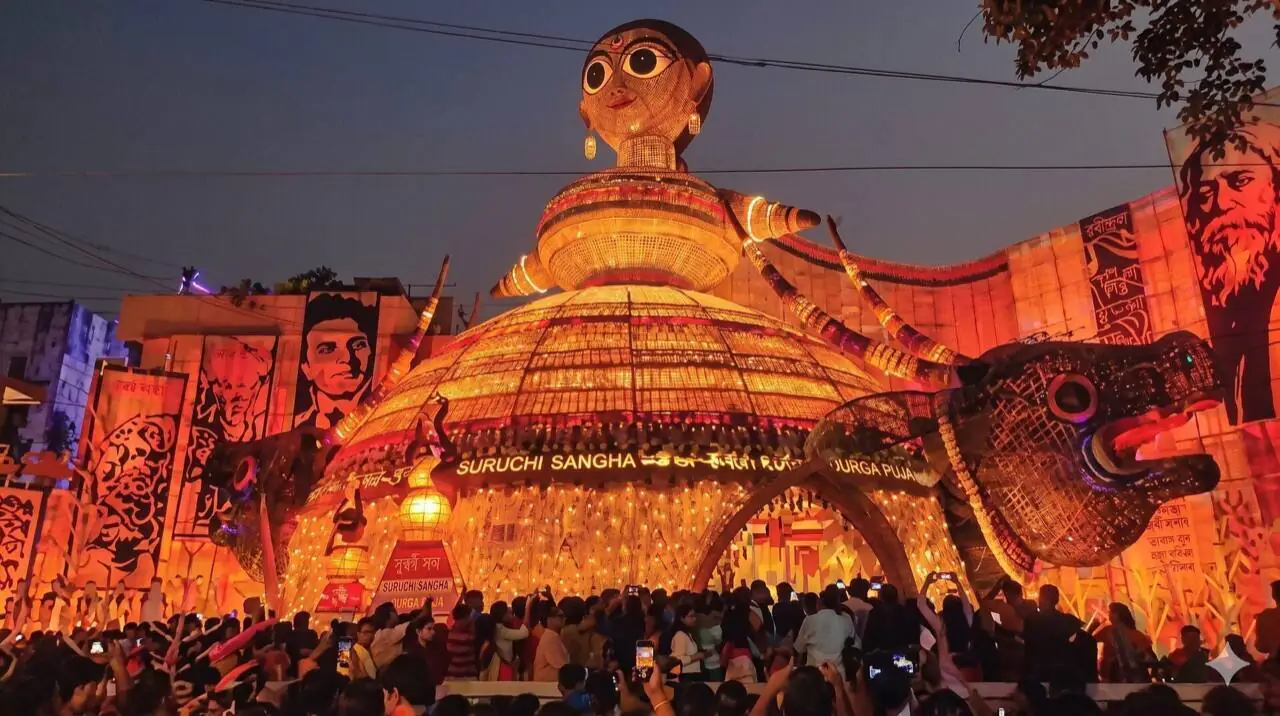
Navami evening is also typically the most crowded night of the festival. The biggest pandals — Sreebhumi, Tala Prattoy, Suruchi Sangha — often have wait times of 2–3 hours. We typically design our packages so that travellers experience the smaller, artistically richer pandals on Navami night when the famous-name ones are at maximum congestion.
Vijaya Dashami — Sindoor Khela and Bisarjan (Oct 10, 2027)
The final day. The mood shifts. The puja is ending; the goddess is being sent home to her husband.
Morning brings Sindoor Khela — one of the most distinctive Bengali traditions. Married women apply sindoor (vermillion) first to the goddess's forehead, then to each other's foreheads, and then smear it on each other's faces as a blessing. It is unrestrained, joyful, and increasingly inclusive — many pandals now welcome women of all marital statuses and (since 2021 in some progressive pandals) transgender women as well.
By afternoon, the city begins its long farewell. Pandal committees lift their idols onto decorated trucks. Drummers walk in front. Crowds dance behind. The processions converge — slowly, over hours, through clogged streets — towards the Hooghly River, where the goddess and her four children will be immersed in the water.
Bisarjan happens on the riverbank. The idols are taken from the trucks, lowered onto boats, rowed out into the river, and tipped gently into the water. The clay dissolves. The frames sink. By midnight on Dashami, the goddess is gone. The pandals come down. The city quiets.
Bengalis say "Asche bochor abar hobe" — it will happen again next year. They say it to themselves, to each other, sometimes through tears. It's not just the end of a festival. It's a small annual rehearsal of letting go.
The Pandals: Thousands of Temporary Cathedrals
A pandal is, technically, a temporary structure. The word is a transliteration of pandala, Tamil for shed. The original pandals were just bamboo-and-cloth canopies erected in courtyards to house the idol during the five-day puja.
What pandals have become in modern Kolkata is something else entirely.
At one end of the spectrum, you still have traditional bonedi bari pujas — the household pujas in old aristocratic homes (Shobhabazar Rajbari, Sovabazar, Daw Bari) where the idol sits in the family courtyard against an ornate but understated traditional backdrop. These pujas are some of the oldest in the city and they continue almost unchanged.
At the other end, you have theme pandals — temporary art installations on a colossal scale, built around a single concept that often takes a year of design work and several months of construction. The best of these are full-fledged cultural events in themselves: complete recreations of medieval Italian piazzas, life-size replicas of European cathedrals, conceptual installations about environmental decay or pandemic memory, immersive sound and light experiences, pandals built entirely from recycled materials or from a single non-traditional substance (cycle parts, plastic spoons, jute, leaves).
The Famous Names
Each year, several pandals draw the biggest crowds. The "famous" list shifts somewhat from year to year (a brilliant theme can elevate an unknown pandal overnight), but a core group of about ten clubs consistently appears among the top draws:
- Sreebhumi Sporting Club (Lake Town, North Kolkata) — known for spectacular themed recreations of world wonders: the Burj Khalifa, the Vatican, the Disneyland castle. Crowds of 100,000+ on peak nights.
- Tala Prattoy (North Kolkata) — consistently artistically excellent, often winning the major pandal awards. Theme work is more subtle and conceptually layered than Sreebhumi's scale.
- Bagbazar Sarbojanin (North Kolkata) — the traditional puja, since 1919. The opposite of theme work — quiet, classical, deeply rooted.
- Kumartuli Park (North Kolkata) — built by the very neighbourhood that produces the city's idols. Every year a meta-comment on craft and tradition.
- Suruchi Sangha (New Alipore, South Kolkata) — a regular winner of the Asian Paints Sharad Samman award. Polished, sophisticated theme execution.
- Behala Friends, Behala Nutan Dal, Behala Club — the Behala cluster (South-West Kolkata) consistently produces three or four of the top ten pandals each year.
- Ekdalia Evergreen (Gariahat, South Kolkata) — known for grand temple-replica pandals; recreated the Akshardham temple, the Brihadeeswarar, the Konark Sun Temple in different years.
- Bosepukur Sitala Mandir (East Kolkata) — pioneered using everyday materials (cycle parts, spoons, terracotta lamps) as the entire pandal material.
- Hatibagan Nabin Pally and Hatibagan Sarbojanin (North Kolkata) — old-school pandals with strong artistic curation.
- Naktala Udayan Sangha (South Kolkata) — frequent award-winner with conceptually ambitious themes.
The Awards
The most prestigious pandal awards are the Asian Paints Sharad Samman (announced before the festival even ends — competition committees secretly visit pandals throughout the five days), and the Berger Color of Joy awards. Winning either is a citywide event. Pandals that have won multiple times — Tala Prattoy, Suruchi Sangha, Naktala Udayan, Bosepukur — develop a permanent reputation that draws crowds in future years.
If you want to see pandals at their artistic peak, follow the previous year's award list. The clubs that won this year will likely have less time and budget pressure next year to top themselves — and the runners-up will be hungry.

Kumartuli: Where the Goddesses are Born
None of this — the thousands of pandals, the millions of devotees, the UNESCO heritage — would exist without one neighbourhood in North Kolkata called Kumartuli.
Kumartuli is a 350-year-old quarter where the city's clay idol-makers — called kumars or shilpis — live and work. About 400 families practise the craft full-time. The skill is hereditary; many of today's master shilpis are the great-great-grandchildren of the artisans who first set up workshops here in the 17th century. The neighbourhood produces thousands of Durga idols every autumn, plus idols of Kali, Saraswati, Lakshmi, and Ganesh throughout the rest of the year. Idols are exported from here to Bengali diaspora communities as far as London, New York, Singapore, Dubai, and Sydney.
The Process
Idol-making is a six-month process. The annual cycle starts roughly six months before Durga Puja, in late spring:
- Clay sourcing (April–May) — The kumars collect Ganges clay from specific points on the Hooghly River. Tradition holds that the most sacred clay must include earth from a brothel — a centuries-old detail that reflects an ancient Bengali principle that goddesses include all forms of human life, including those marginalised. Whether this tradition is still strictly observed varies by family.
- Structure (June–July) — A skeleton is built from bamboo and bound straw, in the rough shape of the final idol — the goddess plus her four children plus the lion plus Mahishasura — all on a single decorated platform.
- First clay layer (July–August) — A coarse mixture of clay and straw is applied to the structure. This first layer is rough and structural.
- Fine clay layer (September) — A finer clay-and-jute paper paste is applied for surface detail.
- Drying (September) — The idol dries naturally. This takes 2–3 weeks. Monsoon humidity is the biggest enemy.
- Painting (late September) — Skin tones, clothing, jewellery, weapons. Every detail. Most shilpis use a mix of traditional pigments and modern acrylic paints.
- Decoration (early October) — Saris, jewellery, weapons, ornamental fabrics are added.
- Chokkhu daan (Mahalaya morning; 30 September in 2027) — The eyes are painted. This is the final step. Once the eyes are painted, the idol is considered alive — and only the master shilpi performs it, usually before dawn, alone.
If you can visit Kumartuli during the puja month (September–October), do it. The narrow alleyways are full of half-finished idols at every stage — bamboo skeletons in one workshop, painted figures in the next, master shilpis with brushes in hand. The dust, the wet clay smell, the religious atmosphere of work that's also worship — there's nothing else like it in India.

The Iconography: Reading the Idol
Once you understand what's in a Durga idol, every pandal becomes more readable. The central composition is always the same, even when artistic interpretation varies wildly.
- Durga in the centre — ten arms, each holding a different weapon, mounted on a lion. The weapons (sword, bow, mace, conch, chakra, lotus, trident, thunderbolt, scimitar, shield) each represent a gift from a different god, pooled together at her creation.
- Mahishasura at her feet — the buffalo-demon being killed. He's usually depicted half-human, half-buffalo, his face contorted in pain, the trident piercing his chest.
- The lion under her — her mount (vahana). Sometimes painted to look almost playful, sometimes ferocious.
- To her right: Lakshmi and Ganesh — the goddess of prosperity, and the elephant-headed god of beginnings. Lakshmi on an owl, Ganesh on a mouse.
- To her left: Saraswati and Kartik — the goddess of learning, and the warrior god of beauty. Saraswati on a swan, Kartik on a peacock.
This entire composition is called Eka-Chala in traditional Bengali style — "one frame" — and it's how Durga has been depicted in Kolkata for at least 200 years. Modern theme pandals sometimes break the composition apart (separating the children into individual installations across the pandal space), but the central five-figure scene is almost universal.
Sound: The Acoustic Identity of the Festival
Close your eyes inside a Durga Puja pandal and you'll hear four distinct sounds, layered.
First, the dhaak — a large barrel-shaped drum hung on a strap around the player's neck, beaten with two thin sticks in a hypnotic rolling rhythm. The dhaki (dhaak player) is the heartbeat of every pandal. The good ones come from rural Bengal each year, paid (and tipped generously) for the five-day shift. The rhythm changes for different rituals: a fast, urgent beat for Sandhi Puja midnight; a slower, dignified beat for Maha Aarti.
Second, the shankha (conch shell). Blown by priests at every threshold of every ritual. Three long blasts signals the start of a major ceremony.
Third, the ululation — a high, ringing call from the throats of older Bengali women, made by trilling the tongue against the roof of the mouth. It's used to bless any sacred moment. When the priests light the lamps for Sandhi Puja, the entire pandal often erupts in collective ululation. It is an extraordinary sound.
Fourth, the mantras themselves — Sanskrit verses chanted in unison during Pushpanjali (the morning flower offering). Hundreds of people, hands joined, repeating verses they may or may not fully understand, in a language none of them speaks day-to-day, all together. It is one of the few moments in modern urban life where you'll see strangers synchronising voice with such tenderness.
Food: The Other Reason People Come
Durga Puja in Kolkata is one of the world's great food festivals — accidentally, because the food culture is just the city's normal food culture turned up to maximum intensity for five days.
Two parallel food worlds run during the festival.
One is bhog — the sacred food offered to the goddess and then distributed to devotees as prasad. Every pandal serves bhog, usually at lunchtime, usually free, usually consisting of khichuri (a one-pot rice-lentil dish with subtle spices), labra (a mixed-vegetable curry), chutney, papad, and payesh (rice pudding). Bhog at a good traditional pandal is one of the best meals you'll eat in India. The Bagbazar puja's bhog is legendary; people queue for hours.
The other world is street food. Kolkata is already one of the world's great street food cities — Park Street's kathi roll birthplace (Nizam's), Decker's Lane's chow mein, the legendary phuchka (Bengali pani puri) of Vivekananda Park, the kosha mangsho at Golbari, the mishti (sweets) shops everywhere — and during Durga Puja, the whole city eats on the streets. Pandal-hopping happens in waves of food breaks. We typically build a food trail into every puja package: ten or twelve stops over the five days, hitting the city's most distinctive street stalls and sit-down classics.
Bengali signature dishes you absolutely should try during the festival: kosha mangsho (slow-cooked mutton), luchi-cholar dal (deep-fried bread with sweet chickpea curry, traditional Sasthi breakfast), shorshe ilish (hilsa fish in mustard sauce, the iconic Bengali fish dish), chingri malai curry (prawns in coconut milk), rosogolla and mishti doi (the two most famous Bengali sweets).


The Numbers: Scale and Economy
To make the scale concrete:
- About 3,500 pandals across Kolkata, and more than 45,000 pujas across West Bengal
- ₹32,377 crore (about USD 4.5 billion) — the British Council's estimate of the creative economy around Durga Puja in West Bengal, roughly 2.6% of the state's GDP (2019)
- 4 million tourists from outside Bengal each year (estimated)
- 2,000+ dhaki (drummers) employed during the five days
- 400 idol-maker families in Kumartuli alone
- 4–6 months of design and construction work for each major theme pandal
- ₹1–5 crore typical budget for a top-tier theme pandal (the largest can run higher)
The festival accounts for a meaningful portion of West Bengal's annual GDP. Sponsorship from corporations is enormous (paints, telecoms, real estate, FMCG brands all compete for visibility). And the festival employs vast numbers of seasonal workers — drummers, decorators, electricians, security personnel, food vendors, idol-carriers — for whom the puja month is a major share of annual income.
Sources: Associated Press (pandals in Kolkata, October 2026); ThePrint (pujas across West Bengal, 2025); British Council (2019).
The Festival In One Line
≈3,500 pandals · 5 days · 1 city
UNESCO-inscribed in 2021. A ₹32,377 crore creative economy (British Council, 2019). The world's largest open-air art event.
For the First-Time Visitor: Practical Notes
If this is your first Durga Puja, a few things will help.
When to arrive
The ideal window is Mahalaya morning (Thursday 30 September 2027) to the day after Dashami (Monday 11 October 2027). If you can't do the whole arc, the absolute minimum useful visit is Saptami night through Navami night (Oct 6–9, 2027) — four nights, the full five-day puja experience without the bookend rituals. If you can only manage two nights, choose Saptami and Ashtami — the latter for Sandhi Puja, the former as your introduction night.
Where to stay
Stay in Central or South Kolkata for best logistics. Park Street, Sudder Street, Chowringhee, Alipore, Ballygunge — all give you good access to North Kolkata's traditional pandals (a 20–30 minute drive) and South Kolkata's theme pandals (most within 15 minutes). North Kolkata itself is denser, more atmospheric, but the heritage hotels there are limited.
For luxury: Oberoi Grand (Chowringhee), Taj Bengal (Alipore), ITC Sonar (Salt Lake), The LaLiT Great Eastern (BBD Bagh), Glenburn Penthouse (South Kolkata). For mid-tier comfort: The Park Kolkata, Pride Plaza Salt Lake, Floatel (a floating hotel on the Hooghly — unique). These fill early for Durga Puja, so the widest choice sits with the earliest enquiries — though a limited number of rooms usually remains close to the festival.
What to wear
Light cotton clothing — Kolkata in October is post-monsoon: 25–32°C, humid but not extreme. For evening pandal visits, you'll be walking and standing for hours; comfortable closed shoes are essential. For Anjali (the formal flower offering on Ashtami morning), traditional Indian attire is appreciated — saree for women, kurta-pyjama for men. Both can be bought (or rented) easily in Kolkata. For the rest of the festival, modest casual is fine.
Pandal-hopping practicalities
You'll cover anywhere from 8 to 20 kilometres of walking on a pandal-hopping day. Pace yourself. The crowds at the famous pandals (Sreebhumi, Suruchi Sangha, Tala Prattoy) can be brutal — wait times of 1–3 hours at peak nights. Smaller traditional pandals and the bonedi bari (heritage household) pujas offer the most atmospheric experiences without the queues. To keep the kilometres down, Agomoni, our Durga Puja 2026 pandal guide, puts every route in walking order with distances measured along the streets.
Our packages always include a private AC vehicle for the night routes — without it, navigating between distant pandals (North Kolkata to Behala can be a 45-minute drive) is nearly impossible during the festival's peak nights. App-based taxis often refuse to accept rides during the busiest hours; private hire is the only reliable option.
Cultural etiquette
- Remove shoes before entering the pandal interior (not the perimeter)
- Photography is welcome at almost all pandals — but ask before photographing priests during rituals, and never use flash inside the sanctum during prayers
- Don't touch the idol
- If a pandal is hosting Anjali (morning flower offering), you can participate respectfully even if you're not Hindu — the priests will guide you. The mantras are sung; you can lip-sync without anyone minding
- Tipping the dhaki is expected and appreciated; ₹100–500 is normal
Health and safety
Crime against tourists is rare in Kolkata; the thing to plan for during Durga Puja is the crowds. The most famous pandals draw very large crowds on the peak nights, and a sudden downpour makes them surge. Visit the headline pandals at quieter hours, keep to routes with clear exits, avoid narrow lanes in heavy rain, stay hydrated, watch for pickpockets in the most crowded pandals (Sreebhumi especially), and have a meeting point planned if travelling in a group. Carry an electrolyte sachet for the long pandal-hopping nights. Don't drink tap water; bottled is everywhere.
Beyond Kolkata: Where Else Durga Puja Happens
Durga Puja is celebrated across India and globally, but Kolkata's version is so much larger and more elaborate that comparison is almost unfair. That said, there are a few other places worth knowing about:
- Mumbai — Large Bengali diaspora, several major pandals (notably in Powai, Lokhandwala, Andheri). Scale: about 5% of Kolkata's.
- Delhi — Bengali Pujas concentrated in CR Park (the "Mini Kolkata" neighbourhood) and Mayur Vihar. Atmospheric but more compact.
- Guwahati — Assam has its own deep Durga Puja tradition; pandals are smaller but the rituals are equally rigorous.
- London, New Jersey, Singapore, Sydney, Toronto — Diaspora pujas of impressive scale; idols are commissioned from Kumartuli and shipped months ahead.
If you can only do one Durga Puja in your life, however, do it in Kolkata. The combination of scale, artistic ambition, food, history, and unrepeatable atmosphere is genuinely unique.
A Final Word: What This Festival Actually Is
It's tempting, after writing 5,000 words about pandals and idols and sacred clay and 200-year-old families, to mistake Durga Puja in Kolkata for a museum piece — a beautifully preserved tradition that you can study and tick off.
It isn't. It's a living, evolving, slightly anarchic event that changes meaningfully every year. The pandals are new every autumn. The themes respond to the year's news — environmental crisis, pandemic memory, Russia-Ukraine, refugee experience, AI, climate grief, whatever a particular committee's artistic director feels strongly about. Some years a single pandal becomes a globally circulated image; some years the whole festival quietly retreats into more classical forms.
It's a religious festival, and it's a contemporary art festival, and it's a five-day citywide street party, and it's a family reunion (real and mythological), and it's a working class economic lifeline, and it's a globally watched cultural moment, and it's a place where a Sikkimese-born Catholic graphic designer and a Bengali Hindu schoolteacher will find themselves standing next to each other at midnight in a tiny pandal, both with their hands joined, neither quite sure why their eyes are wet.
You should come and see it for yourself.
This guide is updated yearly. If you're planning to travel for Durga Puja, start researching early — the best hotels and our most popular packages go first, though we keep a small allocation for late bookings. See our 12 curated Durga Puja 2027 journeys or send us a custom enquiry.
If you found something in this piece useful, or if there's a specific aspect of Durga Puja you'd like us to write about next, write to us at hello@walkanothermile.com. Some of our best Journal posts started as replies to single emails.
— The WAM Team