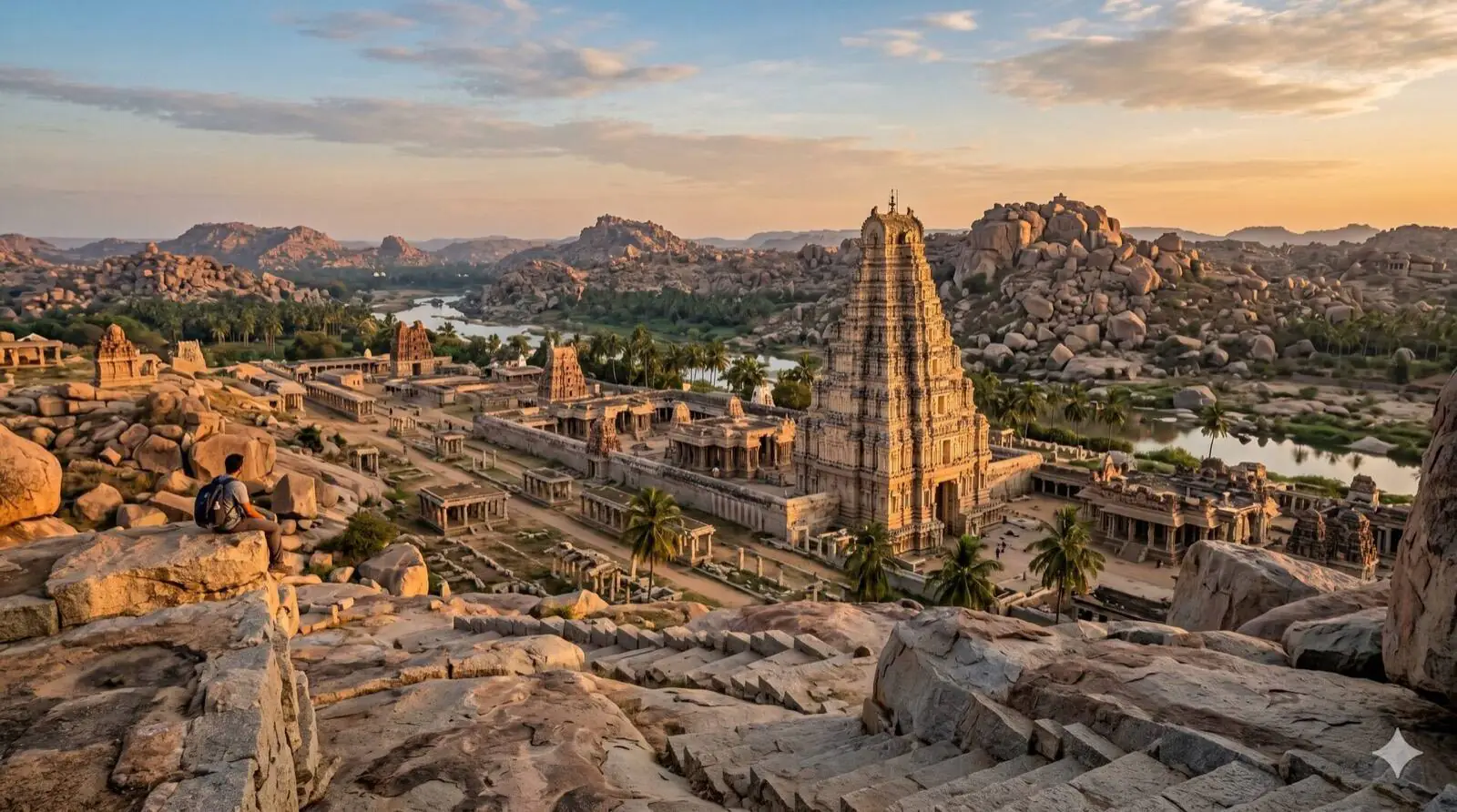
Hampi · Karnataka · UNESCO
Open to visitors of any faithVirupaksha Temple, Hampi
A capital of half a million people was destroyed here in 1565 and never reoccupied. One building kept working, and it is still working.
Hampi is a field of ruins across some twenty-six square kilometres — the wrecked capital of the Vijayanagara empire, sacked in 1565 and abandoned. Virupaksha is the exception. It has been in continuous worship since long before the empire and has never stopped, not even in the year the city died.
The continuity is the point
Almost everything at Hampi is past tense. Palaces, aqueducts, markets, elephant stables, temples — all of it emptied in the sixteenth century and never reoccupied. Walking Hampi is walking an abandoned city.
Virupaksha is present tense. There is a priest, a temple elephant, morning and evening rituals, marriages, families, noise, flowers, the whole apparatus of a functioning shrine. Shrines here date back to at least the seventh century, well before Vijayanagara rose, and worship continued through the sack and the four centuries of abandonment that followed.
That contrast is the single best reason to see Virupaksha properly rather than treating it as one stop among the ruins. It is the difference between an archaeological site and a place where something never stopped happening.
The inverted shadow
Behind the main sanctum is a small dark chamber with a pinhole aperture in the wall. Light from the great eastern gopuram outside passes through it and projects an image of the tower onto the opposite wall — upside down.
It is a functioning camera obscura, built into a sixteenth-century temple, and the effect is unambiguous once your eyes adjust. Whether it was understood optically or arrived at empirically is not documented, but somebody knew what they were doing.
It is easy to miss and most visitors do. Ask a guide specifically for the inverted shadow chamber — the phrase is understood locally — and give your eyes a minute in the dark before deciding you cannot see it.
The wider site, and what not to miss
Hampi is too large to walk in a day and rewards two to three.
The Vittala Temple, about two kilometres from Virupaksha, holds the famous stone chariot — a shrine carved as a processional car, the image on the ₹50 note — and the musical pillars, slender columns which ring at different pitches. They are now roped off after decades of visitors striking them, but a guide can demonstrate on permitted ones.
The Lotus Mahal and Elephant Stables in the Zenana enclosure are Indo-Islamic in idiom rather than Hindu — a reminder that Vijayanagara was in constant architectural conversation with the sultanates it fought.
The Hazara Rama temple, the royal chapel, carries the Ramayana carved in continuous friezes along its walls.
Matanga Hill at sunrise gives the whole boulder landscape at once, and it is a short but genuine scramble. Go early; the light is the point.
The coracle ride on the Tungabhadra is touristic and also genuinely lovely.
Reading Vijayanagara architecture
Hampi is where South Indian temple architecture takes the form most people now picture. The gopuram becomes the dominant vertical element, enclosures multiply outward, and pillared halls grow enormous and increasingly virtuosic.
Virupaksha's eastern gopuram rises around fifty metres in nine tiers. Compare that with Brihadeeswarar at Thanjavur, five hundred years earlier, where the sanctum tower is the tall thing and the gateways are modest, and the whole shift becomes visible in two buildings. Our architecture guide sets out why.
Vijayanagara also produced the kalyana mandapa — the marriage hall — with composite piers where a central column is surrounded by clusters of slender colonnettes carved from the same block. The Vittala temple has the finest examples anywhere.
It is worth remembering the empire was defeated by a coalition of Deccan sultanates at Talikota in 1565, and the city was systematically destroyed over months rather than in a single sacking. The damage you see was deliberate and thorough.
Planning a Visit
Timings & tickets
Virupaksha is open roughly 06:00–17:30. Entry is around ₹40 for Indian, SAARC and BIMSTEC nationals and ₹600 for other foreign nationals (slightly less booked online); children under 15 free. The wider Hampi monuments are separately ASI-ticketed. Verified August 2026.
How long to allow
Two to three days for Hampi. Virupaksha itself is an hour, but the site spans some 26 square kilometres and the good things are spread across it.
Getting around
Bicycles, scooters and auto-rickshaws. The boulder terrain is hard walking in heat. Hire a guide for at least the first day — Hampi is largely unlabelled and much of what matters is invisible without one.
The inverted shadow
Ask specifically for the inverted shadow chamber behind the sanctum. It is easy to miss and most visitors do. Let your eyes adjust before deciding you cannot see it.
Best time
October to February. Hampi is brutally hot from March and the boulders radiate heat all day. The Hampi Utsav in November stages music and dance among the ruins.
Base
Hampi Bazaar on the temple side, or Anegundi across the river for quieter stays. Hosapete (Hospet) is 13 km away with the railway station.
Timings, fees and access rules above were checked in July 2026, but temple administrations change them with the festival calendar and sometimes at short notice. We reconfirm hours, darshan arrangements and any restrictions before every departure — and we book priority darshan in advance where it exists, because the queue is usually the difference between a good visit and a wasted morning.
Travel with us
See This Properly
Private, guided, and timed so you are inside when it matters rather than at the same hour as everyone else.
Start planning →Virupaksha Temple, Hampi, Answered
Yes — it is the one building at Hampi still in continuous worship. Shrines here date to at least the seventh century, before the Vijayanagara empire, and worship never stopped through the 1565 sack or the four centuries of abandonment that followed. Everything else at Hampi is a ruin; this is a working temple.
A small dark chamber behind the sanctum with a pinhole aperture that projects an image of the great eastern gopuram onto the opposite wall — upside down. It is a functioning camera obscura built into a sixteenth-century temple. Ask a guide for it specifically; most visitors walk past.
Virupaksha is around ₹40 for Indian, SAARC and BIMSTEC nationals and ₹600 for other foreign nationals, slightly less if booked online, with under-15s free. The wider Hampi monument group is separately ASI-ticketed. Verified August 2026 — ASI rates are revised periodically.
Two to three. The site covers around 26 square kilometres of boulder landscape and the significant monuments are spread across it. One day covers Virupaksha and Vittala; a third lets you do Matanga Hill at sunrise and the royal enclosure properly.
The Vijayanagara empire was defeated by a coalition of Deccan sultanates at Talikota in 1565, and the capital — then among the largest cities in the world — was systematically destroyed over months and never reoccupied. The damage was deliberate and thorough.
At the Vittala Temple, about 2 km from Virupaksha. It is a shrine carved in the form of a processional chariot and is the image on the ₹50 note. The same complex holds the musical pillars, now roped off after decades of visitors striking them.
Where to Next
Or start with the full Temples of India guide — 120 temples, eleven circuits, architecture and etiquette.
Planning a trip to Virupaksha Temple, Hampi?
Tell us roughly what you have in mind and we will send a considered reply — not a brochure. Usually within 24 hours, Kolkata office hours.